Other

18.12.2025

UGC and PDP: Flowbox or JOIN, two very different visions of activating customer content

Customer-generated content (UGC) has established itself as an e-commerce standard.

Photos, videos, stories or even Reels make it possible to reassure, project and humanize a brand.

But behind the same word - UGC - there are actually two very different uses:

  • show customer content to enrich the experience,
  • or activate this content on the product page to influence the purchase decision.

This is exactly what sets Flowbox and JOIN apart.

Both solutions address the subject of UGC, but with very different objectives, perimeters and business impacts.

Flowbox: collecting and distributing UGC to enrich the experience

Flowbox is a recognized UGC platform, used by many e-commerce brands.

Its positioning is clear: Centralize existing social content and distribute it on the site.

Concretely, Flowbox allows you to:

  • Automatically retrieve content where the brand is mentioned or tagged,
  • manage user rights with creators,
  • organize these contents in a library,
  • display them on the site via various widgets (grids, carousels, PDP modules).

The integration is fast and the promise well kept:

Flowbox makes it easy to add visible, consistent and authentic customer content to an e-commerce site.

In this logic, UGC mainly plays a role of visual enrichment and inspiration:

  • create a social zone,
  • reassure with proof of use,
  • Strengthen the brand image.

The structural limitations of this approach

As soon as the stakes go beyond the display, certain limits appear.

  • The formats remain mostly static or semi-dynamic, with limited interaction on mobile.
  • Content is rarely thought of as active elements of PDP, but rather as a complementary module.
  • The ability to test, compare, or optimize the impact of content is poor.
  • The available indicators focus on engagement (clicks, views), without allowing detailed analysis of their influence on:
    • Adding to the basket,
    • The conversion rate,
    • turnover,
    • or the overall performance of the product page.

Flowbox therefore meets a specific need very well: to show more customer content on an e-commerce site.

But the tool generally stops at distribution.

JOIN: activate content (UGC and videos) as conversion drivers

JOIN takes a substantially different approach.

The objective is not only to display content, but to integrate it into the heart of the buying journey, especially on the product page.

On JOIN, UGCs are not treated as a separate category, but as one type of content among others, in the same way as:

  • product videos,
  • instructional videos,
  • Branded videos,
  • or influencer content.

All of these formats can be used, combined and activated in a single logic: Advance the purchase decision.

From social UGC to shoppable video

JOIN allows you to:

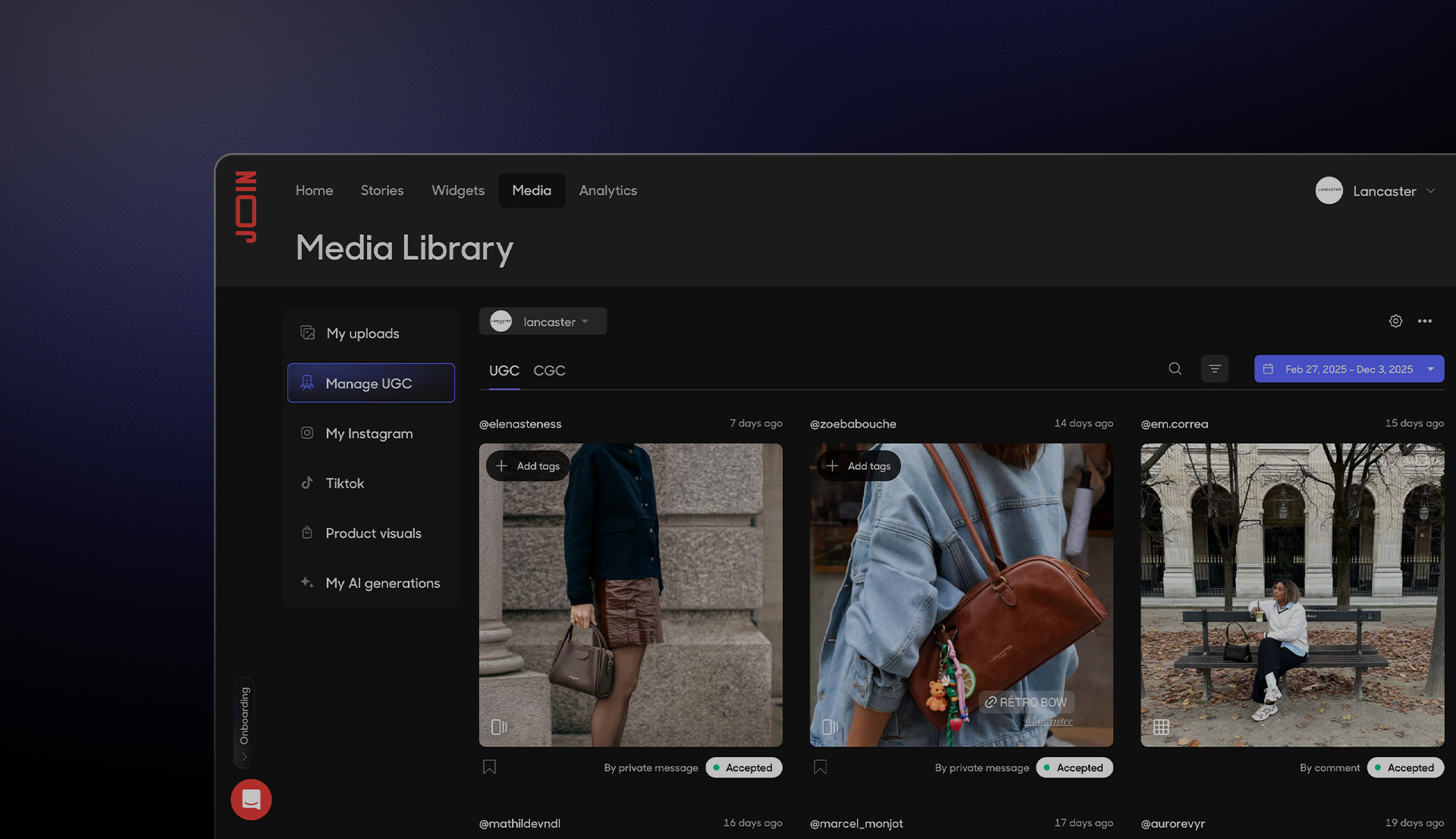
  • Automatically raise social content (stories, posts, reels),
  • Manage rights requests in one click,
  • automatically unpublish content when the rights expire,
  • Transform this content into shoppable videos.

UGC content is no longer simply displayed: it becomes an interactive e-commerce Web Story, integrated directly on the HP or within the PDP, with product tags and a path designed for conversion.

A customer shows a product in an Instagram story: this content can be activated in a few minutes as a proof of use that can be clicked on the right product page.

A key difference: control and measurement

One of the major differences between Flowbox and JOIN lies in the ability to measure and optimize.

Each content activated via JOIN is analyzed according to its real impact on the buying process:

  • Adding to the basket,
  • conversion rate,
  • turnover generated,
  • Contribution to the performance of the PDP.

UGC is no longer limited to “performing well visually”: it becomes a measurable lever, comparable to other elements on the page.

JOIN goes further by integrating an A/B testing module, allowing you to test:

  • The presence or not of stories,
  • their position on the page,
  • The best performing type of content (UGC vs product video, for example).

This approach allows e-commerce teams to answer concrete questions:

  • What Content Really Influences the Purchase?
  • What formats should be prioritized?
  • What PDP configuration maximizes conversion?

Two distinct uses of UGC

In the end, Flowbox and JOIN do not meet the same need.

Flowbox is for brands looking to:

  • automatically collect UGCs,
  • Easily distribute them on their site,
  • enrich the visual and social experience.

JOIN is designed for teams who want to:

  • integrating content into the heart of the PDP,
  • manage their business impact,
  • continuously optimize the performance of product pages,
  • orchestrate UGC, product videos and educational content in the same course.

Choosing between Flowbox and JOIN

The choice between Flowbox and JOIN depends less on the volume of UGC than on the e-commerce maturity of the team.

  • If the main objective is to display customer content to reinforce social proof, Flowbox effectively meets the need.
  • If the objective is to use content as a measurable and optimizable conversion lever, JOIN offers a more comprehensive approach.

This explains why several brands: Jonak, Tikamoon, Julbo, Julbo, Julbo, Mileade or Berah Gettah have evolved their UGC stack to JOIN.

In summary:

  • Flowbox highlights customer content.
  • JOIN transforms them into active elements of the buying journey.

Two visions of UGC.

Two levels of impact on e-commerce performance.

{{cta}}

Discover more content on the same subject.

Other

UGC and PDP: Flowbox or JOIN, two very different visions of activating customer content

Read the article
Other

How Tarte dominates TikTok Shop: the creator-led model that generates millions

Read the article
Other

TikTok Shop in 2025: trends, winning strategies and exclusive insights from the French market

Read the article

What if we showed you JOIN,

on your own site?